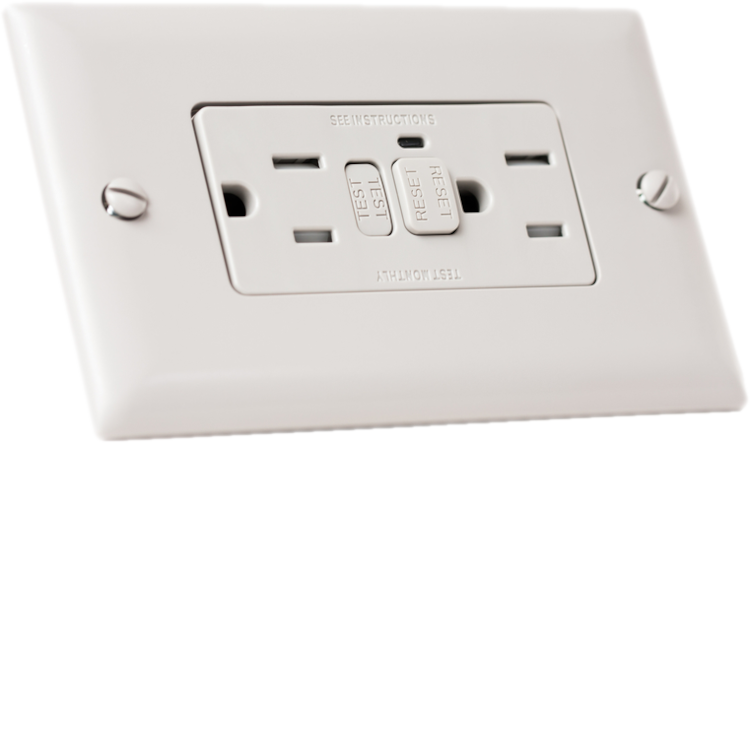
Residual-current Device
Information from:
A residual-current device (RCD), residual-current circuit breaker (RCCB) or ground fault circuit interrupter (GFCI) is an electrical safety device, more specifically a form of earth-leakage circuit breaker, that interrupts an electrical circuit when the current passing through line and neutral conductors of a circuit is not equal (the term residual relating to the imbalance), therefore indicating current leaking to ground, or to an unintended path that bypasses the protective device. The device’s purpose is to reduce the severity of injury caused by an electric shock. This type of circuit interrupter cannot protect a person who touches both circuit conductors at the same time, since it then cannot distinguish normal current from that passing through a person.
Thank you
# # # #
Information from: Occupational Safety and Health Administration
Figure 1 - Effects of various levels of current through the human body
A ground-fault occurs when there is a break in the low-resistance grounding path from a tool or electrical system. The electrical current may then take an alternative path to the ground through the user, resulting in serious injuries or death. The ground-fault circuit interrupter, or GFCI, is a fast-acting circuit breaker designed to shut off electric power in the event of a ground-fault within as little as 1/40 of a second. It works by comparing the amount of current going to and returning from equipment along the circuit conductors. When the amount going differs from the amount returning by approximately 5 milliamperes, the GFCI interrupts the current. The GFCI is rated to trip quickly enough to prevent an electrical incident. If it is properly installed and maintained, this will happen as soon as the faulty tool is plugged in. If the grounding conductor is not intact or of low-impedance, the GFCI may not trip until a person provides a path. In this case, the person will receive a shock, but the GFCI should trip so quickly that the shock will not be harmful. The GFCI will not protect you from line contact hazards (i.e. a person holding two "hot" wires, a hot and a neutral wire in each hand, or contacting an overhead power line). However, it protects against the most common form of electrical shock hazard, the ground-fault. It also protects against fires, overheating, and destruction of wire insulation.
Thank you Occupational Safety and Health Administration
Figure 2 - A typical residential 120 VAC GFCI duplex receptacle
"WR" identifier quickly indicates during inspections that a weather resistant receptacle has been installed. Both the "TR" mold mark (tamper resistant) and "WR" identifier are clearly visible in the finished installation, indicating double-layer protection for maximum safety. Information from: Eaton's Tamper and Weather Resistant Receptacles (A PDF document)
Figure 3 - A very rudimentary operating diagram of a GFCI receptacle operating normally
Figure 4 - The same GFCI has “tripped” because of a ground-fault
A GFCI is designed to function in the following manner:
1 - The GFCI constantly measures current flowing into and returning from a utilization device.
2 - It compares the amount of current entering the device to the amount returning.
3 - These two currents should be equal if everything is operating as intended.
4 - The GFCI is designed to function when an imbalance between these currents occurs.
5 - This fault imbalance is generally set to trigger the GFCI at between 4 to 6 milliamps (mA). 5 milliamps is generally the industry standard.
6 - An imbalance indicates that some current is flowing to ground through an abnormal path - perhaps through a human body.
7 - Many GFCIs react - disconnect power - within 25 milliseconds (ms) - 1/40 of a second.
8 - A quick response time is necessary to prevent injury or electrocution.
Figure 5 - A single-pole GFCI circuit breaker for personal protection (Eaton)
Figure 6 - A wiring diagram for GFCI circuit breaker at the loadcenter (Circuit Breaker Panel)
Figure 7 - A Cord-Connected GFCI Image from:
The Cord-Connected Type of GFCI is an attachment plug incorporating the GFCI module. It protects the cord and any equipment attached to the cord. The attachment plug has a non-standard appearance with test and reset buttons. Like the portable type, it incorporates a no-voltage release device that will disconnect power to the load if any supply conductor is open. Note: A no-voltage release device in a GFCI is a safety feature that disconnects power to the outlets if any supply conductor is open, preventing the GFCI from resetting until the problem is fixed. This is especially common in portable or cord-connected GFCIs, which disconnect power if a “hot” wire is broken. This ensures that power is not restored until the issue causing the open circuit is resolved and it’s safe to do so.
Figure 8 - Two Portable GFCIs Image from:
Portable Type GFCIs come in several styles, all designed for easy transport. Some are designed to plug into existing non-GFCI outlets, or connect with a cord and plug arrangement. The portable type also incorporates a no-voltage release device that will disconnect power to the outlets if any supply conductor is open. Units approved for outdoor use will be in enclosures suitable for the environment. If exposed to rain, they must be listed as waterproof.
When and Where are GFCI Receptacles Required?
A “ground-fault” is an unintentional flow of electricity between a source of electrical current and a grounded surface. Without protection, electrical shock can occur if a person comes into contact with an energized part. For example, if a person is holding a damaged electrical cord from a hair dryer and touches a plumbing fixture, they could be electrocuted. They would certainly get a painful shock.
A GFCI receptacle constantly monitors an electrical circuit. If it detects even a slight flow of electricity to a grounded item, it immediately shuts off the flow of electricity. This protects people from electrocution. It is particularly important to protect people where they could come in contact with exposed grounded items such as plumbing fixtures.
If too much electricity flows through a wire, it will get hot. Sometimes it can get hot enough to start a fire inside the walls of a house. Traditional circuit breakers protect your house from fires by shutting off the flow of electricity to a wire when there is too much demand for electricity. This can happen when too many items are plugged into a circuit. That's why a power strip can be dangerous if there are too many electric items plugged into it. Circuit breakers do not protect people from electrocution. Their purpose is to protect you from a fire.
GFCI receptacles were required in houses starting in 1971. Originally they were only required at the exterior of the house and by swimming pool equipment. Over the years, GFCI receptacles have been required in more locations such as garages, bathrooms, kitchens, etc. The following table applies to most municipalities, but some local codes may be different.
Figure 9 - Year and Location GFCIs Were Required (Approximate - may vary by jurisdiction)
Does each receptacle need to be a GFCI receptacle?
In most cases, no. For example, all of the bathroom receptacles throughout a house can be protected by one GFCI receptacle. This is true for the receptacles at a kitchen counter that are required to be GFCI protected. You may only see one GFCI receptacle, but all down-circuit receptacles can be protected if installed properly. The GFCI receptacle simply needs to be located closest to the breaker on that circuit. It will protect all of the down-circuit “ordinary” receptacles.
Figure 10 - GFCI Protection for Down-circuit “ordinary” Receptacles
Installing and Testing a GFCI Receptacle
Information from: (Get the following information here in a PDF file)
Install & Test GFCI 1 - CLICK OR TAP FOR A LARGER IMAGE
Install & Test GFCI 2 - CLICK OR TAP FOR A LARGER IMAGE
Install & Test GFCI 3 - CLICK OR TAP FOR A LARGER IMAGE
Install & Test GFCI 4 - CLICK OR TAP FOR A LARGER IMAGE
Install & Test GFCI 5 - CLICK OR TAP FOR A LARGER IMAGE
Install & Test GFCI 6 - CLICK OR TAP FOR A LARGER IMAGE
Install & Test GFCI 7 - CLICK OR TAP FOR A LARGER IMAGE
Figure 11 - Maximum Trip Time to Current Relationship
Figure 12 - Trip Time to Current Relationship Graph
Figure 13 - Maximum Trip Time Calculator
Figure 14 - Maximum Trip Times
Figure 15 - A GFCI Receptacle Description
Figure 16 - A GFCI Switch
Figure 17 - A GFCI Switch Description
bob@infoforyouand.me
A Gotta Run!™ Presentation